Meet The Pediatrician an NIH Assistant Director Called a “Clown”.
When a Florida pediatrician spoke up on vaccines, an NIH-linked Facebook account came after him. Here's his side.
By Broken Truth
NIHGate Part 2: “You Are a Clown.” An NIH Official’s Facebook Account Versus a Florida Pediatrician
When a Florida pediatrician spoke up on vaccines, an NIH-linked Facebook account came after him. Here’s his side.
I didn’t go looking for Dr. Brian Thornburg.
I went looking for Ajay Vatave.
If you read my last NIHGate piece, you know how this started. I posted a photo with Russell Brand. A man named Ajay Vatave showed up in the comments. His Facebook profile lists the National Institutes of Health, Chevy Chase, Maryland, and UC Santa Cruz. I had a hunch this wasn’t his first time.
It wasn’t.
In a very short amount of time I was able to uncover a treasure trove of posts from the Ajay Vatave facebook account. About eleven or twelve weeks earlier, on a Facebook reel by Dr. Thornburg Wellness called “Vaccines & The Immune System Pt. 2,” the same account went to work. I screen-grabbed what I found. According to what I’ve been told, those comments have since been deleted. The screenshots are below.
Who is Dr. Thornburg?
Dr. Brian Thornburg is a board-certified pediatrician in Naples, Florida. He has practiced since 2003. He told me he serves as medical director of the child abuse team in Collier County. He has eight kids. By his own account, he was a philosophy major before he ever took a science class.
He calls himself the “informed consent pediatrician.” That is how he came to medical freedom: slowly, through his own patients’ questions.
“I said, well, let me see the literature that you’re looking at,” he told me. “Here I was expecting to set the record straight for them because they weren’t doctors, and I ended up being the one that was flipped.”
The reel
In the video, Thornburg pushed back on pediatric influencers who argue that a baby crawling on the floor meets thousands of antigens, so a few more from shots are nothing. His point: route and timing matter. Germs on the floor meet the body’s mucosal defenses. A shot goes into the muscle.
“The route that we intake of virus, bacteria, or fungus matters,” he told me. “The timing of an introduction of virus, bacteria, or fungus matters.”
You can agree or disagree. That’s what debate is for.
Enter the troll
Here is how the comment from the Vatave account opened, exactly as written:
“I am happy to debate you and I will completely obliterate your BS with actual valid biomedical studies…and hey if you are so confident why don’t you take down your disclaimer and hold yourself liable…that was rhetorical we both know why you won’t do that…you are a clown.”
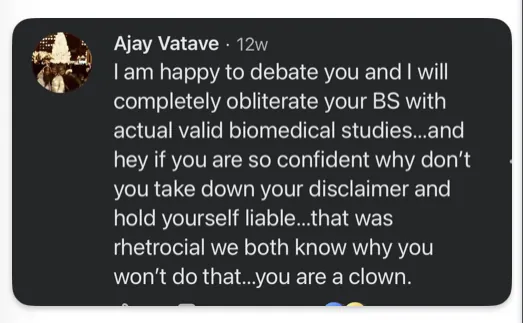
I asked Dr. Thornburg whether he had ever worked in a circus. He said no. So that claim doesn’t check out.
When Thornburg accepted the debate, the account replied:
“great, I’ll attend. This will defintely not go well for you, but if you want to put yourself out there with ZERO scientific basis ok. I have two conditions: One, you confirm your state medical board participation. Two, you remove your cheeky medical disclaimer from all of your social media posts.”
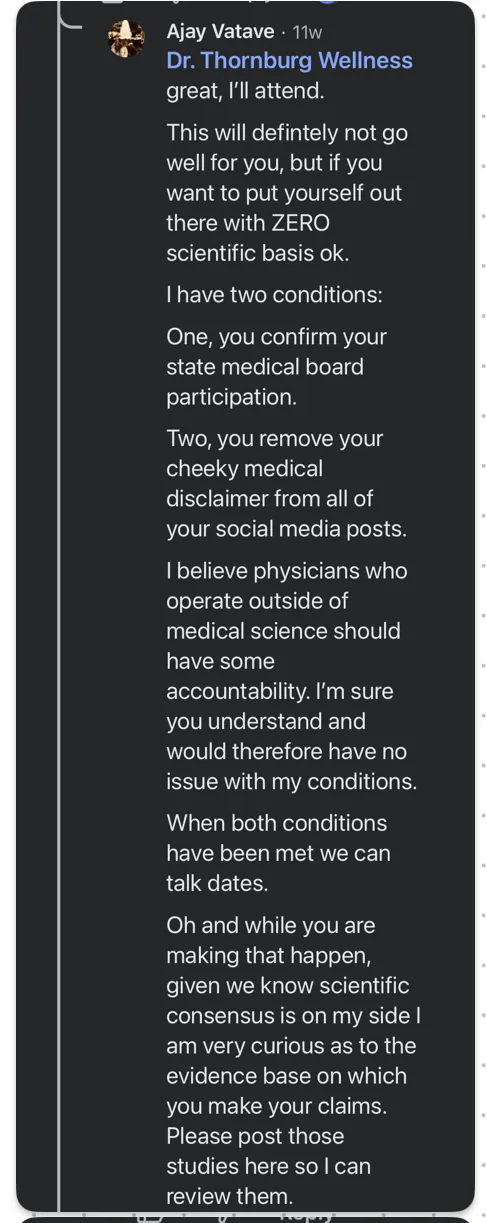
Read that first condition again. Confirm your state medical board participation. Why is that condition number one in a debate about immunology?
Thornburg wasn’t rattled. “This wasn’t my first rodeo on somebody threatening me,” he said. Of physicians who threatened to report him during COVID, he said: “Nobody can take that license away.”
As for the “cheeky” disclaimer, he checked who else posts one. “The CDC does it. Johns Hopkins does it,” he told me. “Mayo Clinic does it.”
“Explain.”
Next came the credential check:
“well you know what is interesting to me right now is I can not find one published study from you in pubmed..explain.”
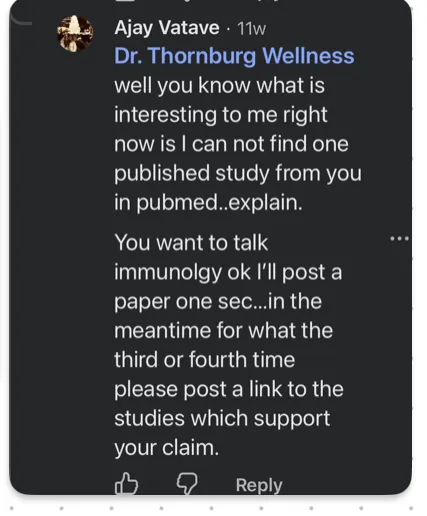
Then:
“now we know you are not, that’s fine at least everyone here knows now you haven’t conducted any scientific studies in this space…”
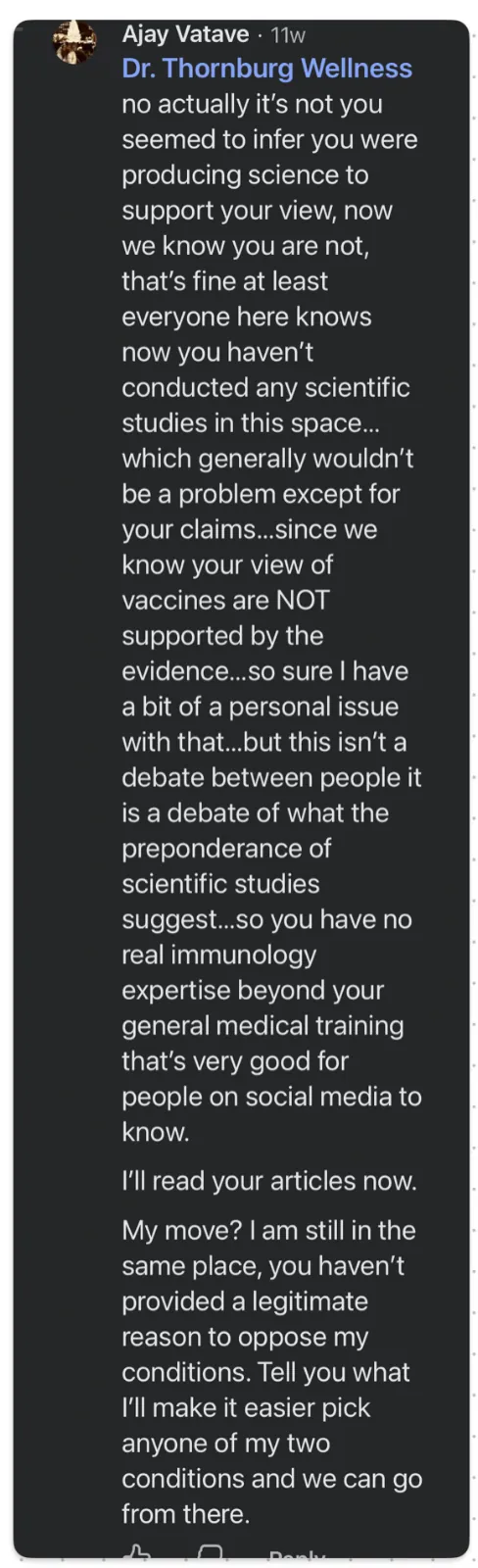
Thornburg’s answer: practicing physicians read research and apply it. That’s what journal club is. They don’t treat researchers “as if they were a clergy.” Demanding a publication record before you’ll engage “is just another version of an ad hominem attack.”
The papers
To his credit, the account did post sources. I looked up every one.
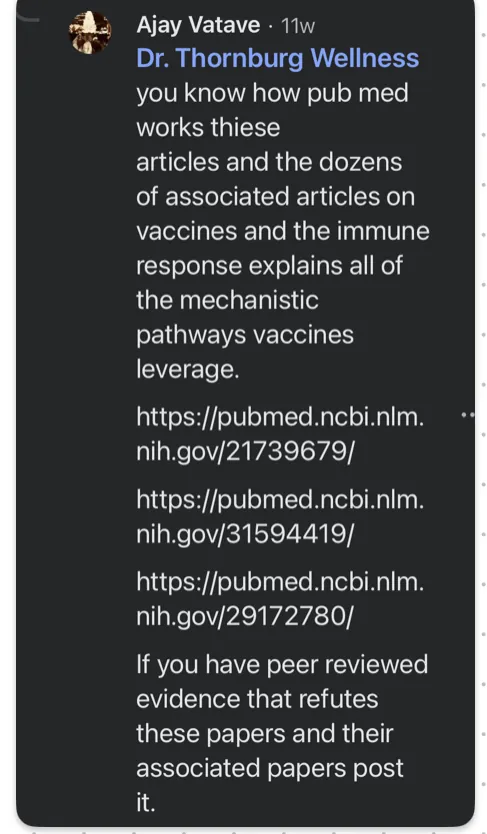
- PMID 21739679: Pulendran & Ahmed, “Immunological mechanisms of vaccination,” Nature Immunology, 2011.
- PMID 31594419: Sell, “How vaccines work: immune effector mechanisms and designer vaccines,” Expert Review of Vaccines, 2019.
- PMID 29172780: Vetter et al., “Understanding modern-day vaccines: what you need to know,” Annals of Medicine, 2018. The authors are listed with GSK and MSD (Merck).
- PMC9324514: Howard et al., “Understanding Immune Responses to Viruses—Do Underlying Th1/Th2 Cell Biases Predict Outcome?” Viruses, 2022.
These are legitimate review papers. They explain how vaccines produce immunity. But none of them is a safety trial of the infant schedule given all at once, and that was the question on the table. One of the three “explain all of the mechanistic pathways” papers was written by people at two vaccine manufacturers. The Pulendran paper itself says most successful vaccines “have been made empirically, with little or no immunological insight.”
Even the account’s last reply conceded ground on the Th1/Th2 “skew” Thornburg raised: “skew is real and skew may have health impacts, the degree of impacts doesn’t seem to be quite well understood at this point…”
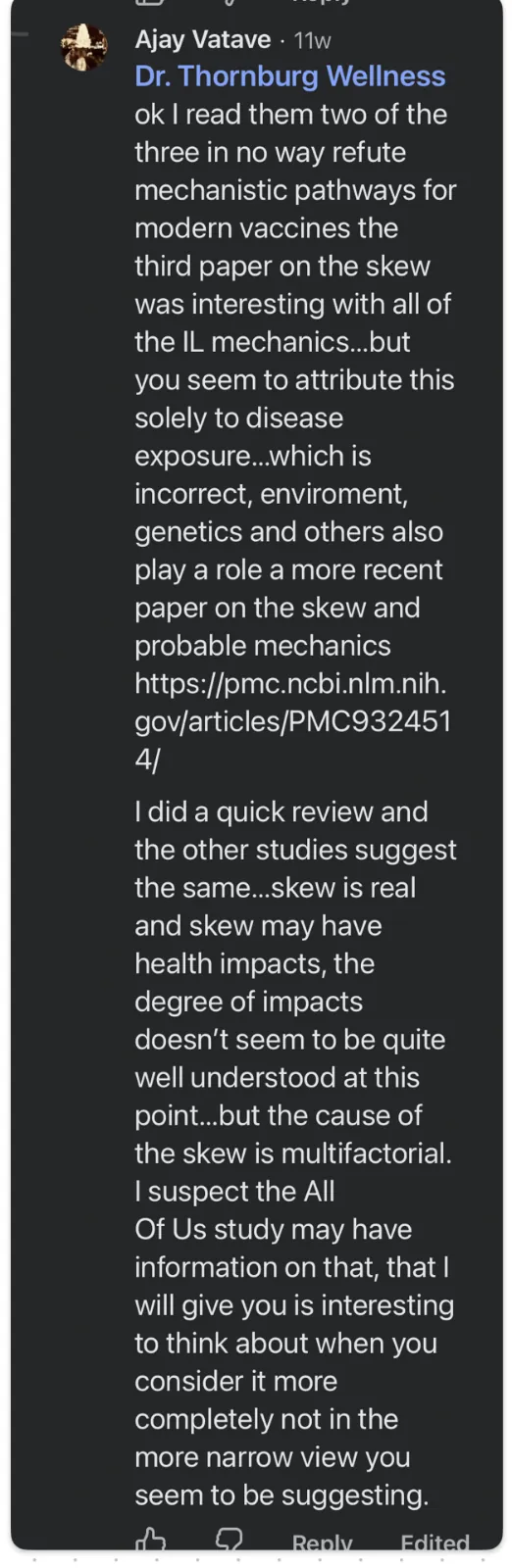
Not quite “obliterated.”
Who is Ajay Vatave?

His Facebook profile lists the National Institutes of Health. Public NIH pages list an Ajay Vatave, M.D., M.P.H., as Assistant Director for Tools and Analytics in the Office of Evaluation, Performance, and Reporting, inside the NIH Director’s office. Conference bios describe him as a public health physician who built NIH’s system for tracking research investments.
He demanded that Dr. Thornburg “confirm” his state medical board participation. So I checked his. On October 17, 2026, searches of the Maryland Board of Physicians and the Virginia Department of Health Professions license lookups found no medical license under his name, and the federal NPPES NPI Registry lists no provider number for him.
To be fair: an MBBS or M.D. is a recognized medical degree, and many NIH administrative and analytics roles don’t require a clinical license. I’m not saying he’s practicing medicine. I’m saying the man who asked a practicing pediatrician to confirm his board standing doesn’t appear in the databases I searched.
To be clear: I have no evidence that he posted on NIH time, or that he spoke for the NIH. These look like personal posts.

But here’s my question. If a taxpayer-funded official tells a practicing pediatrician to “confirm your state medical board participation” before he’ll talk science, what is that supposed to accomplish?
Thornburg put it plainly. “I am coming to this with good faith and with science, and this guy is turning it into, you know, to use his word, a circus.”
And this: “I have yet to meet any of you who haven’t just put up a series of conditions.”
The debate never happened.
The MD on the Website
In the interview, Dr. Thornburg and I also talked about another doctor: Dr. Mandeep R. Mehra of Brigham and Women’s Hospital, a co-author of the retracted Surgisphere hydroxychloroquine study I covered in Epidemic of Fraud.
Mehra was the lead author of the May 22, 2020 Lancet study, built on Surgisphere data, that claimed hydroxychloroquine raised the risk of death. Three days later, the WHO paused the hydroxychloroquine arm of its Solidarity trial. Less than two weeks after publication, Mehra and two co-authors retracted it, writing that “we can no longer vouch for the veracity of the primary data sources,” and a Surgisphere paper he led in the New England Journal of Medicine was retracted the same day. Mehra said, “I no longer have confidence in the origination and veracity of the data, nor the findings they have led to.“ That story is at the heart of Epidemic of Fraud. And this is the doctor whose hospital listing says MD.
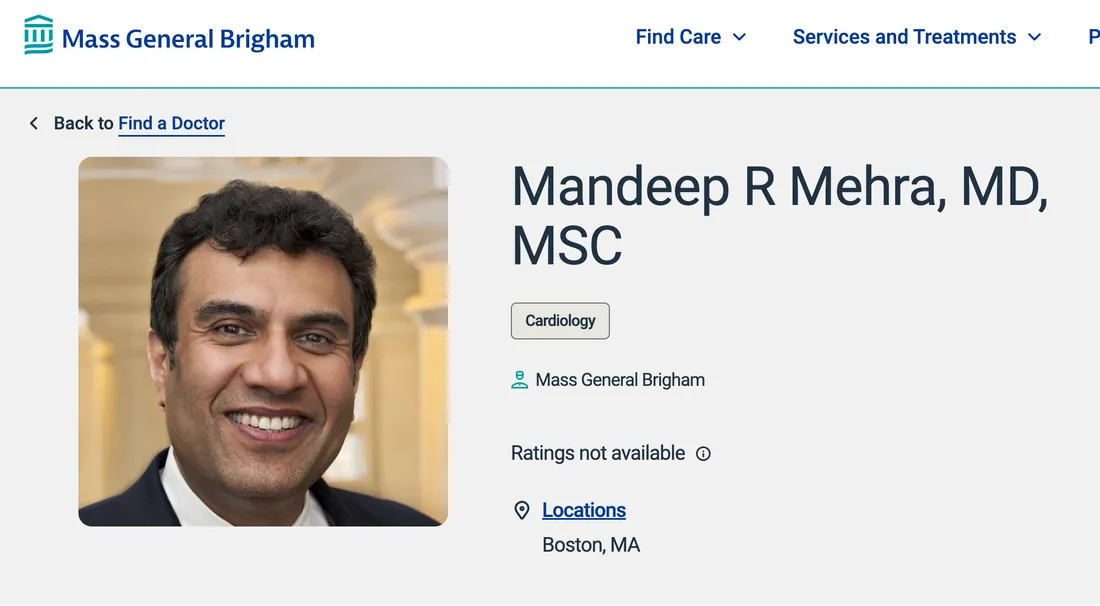
Mass General Brigham’s profile lists him as “Mandeep R Mehra, MD, MSC.” Scroll down to his training and there it is: “MBBS training requires a mandatory internship year to achieve licensure.”
In this excerpt from Epidemic of Fraud, Mehra appears in a May 2020 TV interview saying: “it is high quality evidence the off label use of these medications in hospitalized patients with covid should immediately stop.”
Here’s my view. MD stands for Medicinae Doctor, Latin for “Doctor of Medicine.” In the U.S., it’s earned after a four-year college degree and four years of medical school. MBBS stands for Bachelor of Medicine, Bachelor of Surgery, two bachelor’s degrees, usually started straight out of high school. When patients see “MD” after a name, most assume the American path. When a hospital lists “MD” for a doctor whose degree is an MBBS, patients deserve to have that disclosed. They should know the doctor treating them may have years less formal education than an American-trained MD. Yes, U.S. medical boards license MBBS graduates, once they pass a separate foreign-graduate certification and complete a U.S. residency. That doesn’t change what the letters on the website tell a patient. That’s informed consent.
Mehra has been open about it himself. On the Parallax podcast (Radcliffe Cardiology, uploaded January 4, 2022), he said he went to Columbus, Ohio “after finishing my MBBS, which is the undergraduate medical degree in India, the equivalent of the MD degree in the US.”
He said that as he “was finishing med school,” he met Sister Elizabeth Burns, an Ohio State professor working with USAID, who invited him to the United States. He also said, “my birth date is also the birth date of heart transplantation.” That’s December 3, 1967. His Radcliffe bio and Wikipedia give the same date.
Now the math. His training records list medical school ending in 1987 (Radcliffe calls him part of the “1983 batch”), a Delhi internship in 1988, residency at Mount Carmel in Columbus from 1989 to 1992, and fellowships at Ochsner from 1992 to 1995.
In the interview I said he graduated at 21. The records say it was even younger. Calculated from those published dates, he finished his MBBS at about 19 and started his U.S. residency at about 21. A typical American doctor finishes medical school around 26.
To be fair: Mehra completed full U.S. residency and fellowship training, and he is board certified in internal medicine, cardiovascular disease, and advanced heart failure and transplant cardiology. I’m not saying he isn’t qualified. I’m saying patients should know what the letters mean.
I’m working on a deeper dive into international medical graduates, how they’re paid, and the gap between an MBBS and an MD that U.S. patients aren’t being told about. Subscribe so you don’t miss it.
Watch the moment for yourself:
Listen to the full interview
My full conversation with Dr. Thornburg is on BrokenTruth.TV. We cover his path from banker to pediatrician, the playbook used against doctors who question vaccines, and much more.
Listen to the episode. Then decide for yourself who brought the science, and who brought the conditions.
More NIHGate to come.
Originally published on BrokenTruth.TV.